

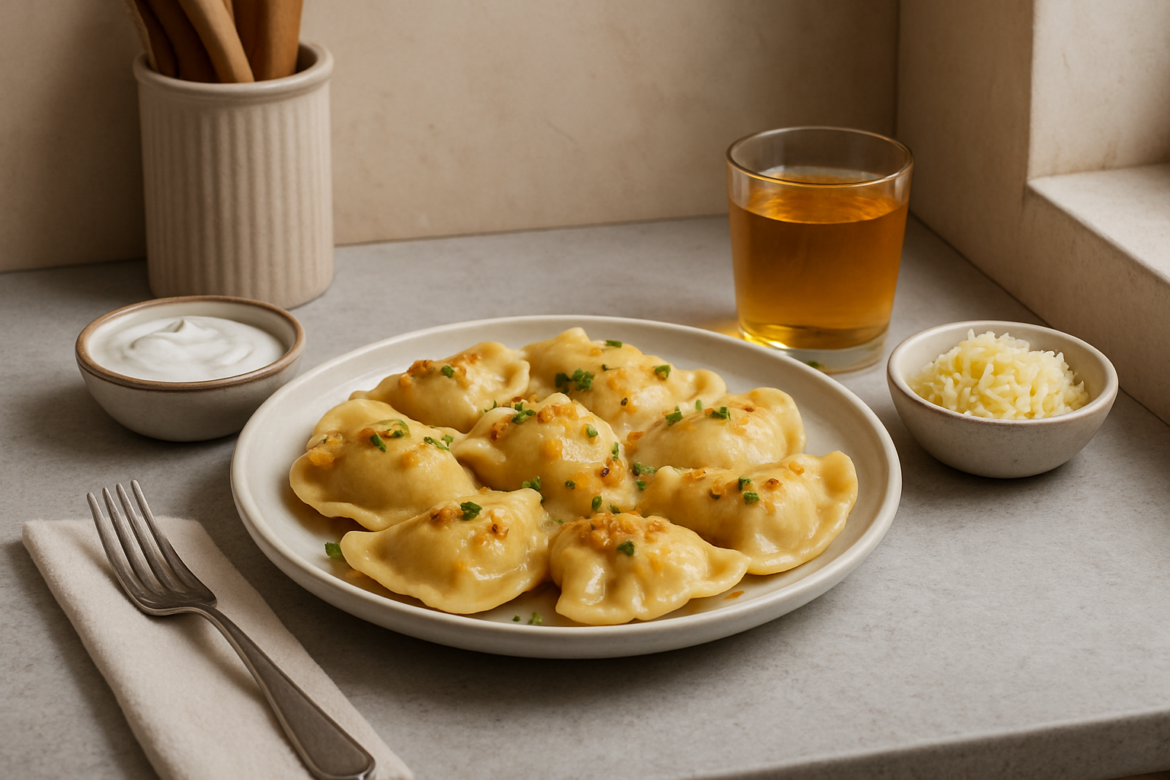
Setting Up a Pierogi Dinner on a Tiny Counter
A tiny counter can support a comfortable pierogi dinner if it has a clear job at each stage. Decide where hot cookware will land, reduce the number of serving vessels, and move finished components to the table before the main cooking begins. Choosing mini or full-size dumplings comes after that layout decision, because smaller food does not automatically require less kitchen equipment.
Choose the landing spot for hot cookware
Look at the kitchen as it will be during preparation, not as it appears when everything is put away. A cutting board, an opened package and a bowl can occupy most of a short counter. Add the cookware required by the product instructions and the remaining space may disappear. Reserve an appropriate heat-safe landing place before you start, using the protection and clearances your kitchen surfaces and cookware require.
Do a simple dry run with empty dishes. Set the plate where you expect to fill it, place the serving utensil nearby and check that you can reach the cooking area without moving a chair or leaning over another dish. This is particularly useful if the dining table sits outside the kitchen. A short distance is not helpful when the route is blocked by an open cupboard or a bag of groceries.
The sink should have a defined role too. If your package-approved preparation needs access to it, clear the dishes first. A sink full of breakfast bowls can turn an otherwise straightforward dinner into a last-minute rearrangement. Avoid balancing cookware on unstable items or improvising a landing area when the food is ready. The moment to find the missing trivet is before anything becomes hot.
Choose equipment by the instructions and the amount you intend to prepare. Mini dumplings are a serving format, not permission to crowd cookware or ignore preparation directions. Full-size dumplings may work perfectly well in a small kitchen when the cook has planned the space. The relevant purchase question is whether you can prepare the actual product properly with the equipment you own.
A small kitchen often benefits from using the dining surface as the destination for finished, ready-to-serve components. Put water glasses and place settings there in advance. Keep raw-food preparation and other kitchen tasks in their appropriate areas rather than treating the table as an indiscriminate extension of the counter. Each object moved should have a useful final position.
Let one bowl hold the finishing ingredients
Several topping bowls can consume more room than the main food. Choose a finish that makes sense as one component, such as a familiar dressing for a separate salad or a single dip for the dumplings. You can still offer choice by leaving that bowl off the main plate. Flexibility does not require every herb, condiment and chopped vegetable to occupy its own dish.
Prepare the finishing component first when its ingredients and storage needs allow. Put it in the vessel from which it will be served, then store it appropriately until the meal is ready. This avoids making a sauce in one bowl, transferring it to another and leaving both on the counter. The same principle works for a simple vegetable side that can be served in its preparation bowl.
For a Raleigh shopper considering a dipping format, Holy Perogy in Raleigh describes Poppin’ Cheddar Bites as mini potato-and-cheddar pierogies. That is a useful distinction if your plan is a small plate with one dip. It does not tell you the package footprint or how many pieces your dinner should contain; make those decisions from the actual package and your intended meal.
Think about how the finish reaches the food. A dip bowl needs a stable place beside a plate. A dressing needs a spoon or another suitable way to serve it. If the only available table space is already crowded, the better answer may be to dress each person’s side in the kitchen rather than add another shared object. Let the room dictate the service, then choose the food presentation.
Do not confuse fewer dishes with fewer meal components. A plate can hold cooked dumplings and a separately prepared vegetable without needing a large platter between them. If cheese is already in the filling, a second cheese-based finish is optional. A bright or crisp accompaniment may give the meal a different character while leaving the counter arrangement simple.
Clear a path from package to table
Keep the product instructions readable during cooking. An opened package tucked under a wet cutting board is difficult to consult, and memory is a poor substitute when the food is unfamiliar. Holy Perogy products are frozen and uncooked; follow the directions for the product in front of you. Return any reserved uncooked portion to its required storage instead of letting it occupy the counter throughout dinner.
Work through the meal in a sequence that releases space. Finish the cold side, put away its ingredients and clean the preparation area before beginning the main cooking. Set out the serving utensil while you can still reach the drawer easily. This is less about speed than about preventing several unfinished jobs from demanding the same few inches at once.
Consider whether a communal platter adds anything useful. For one or two diners, serving directly onto individual plates may remove an unnecessary transfer and one large object. For a shared meal, a modest serving dish that fits the table can still be appropriate. Choose it because people will use it comfortably, not because a dinner photo usually includes an oversized centerpiece.
After the food reaches the table, the kitchen should not need an immediate emergency reset. Put utensils somewhere stable, deal with remaining food appropriately and leave hot equipment safely positioned. A clear route allows you to sit down without worrying that the next person entering the room will knock something aside.
Keep the layout that worked. The next time you cook, remember the useful arrangement: a protected landing spot, one finishing vessel and plates already waiting. A small counter becomes easier to use when its jobs happen in order.
The Short Version
- A tiny counter can effectively support a pierogi dinner if each stage of the meal preparation has a designated purpose.
- Choosing the size of dumplings should follow the decision on counter layout, as smaller food does not necessarily require less kitchen equipment.
- Avoid cluttering the counter with items like the sink, dishes, and a crowded workspace to streamline meal preparation and serving.
- Preparing a single finishing component in one bowl can conserve space and simplify serving as opposed to multiple side dishes.
- Maintaining a clear path from the product package to the dining table is essential for an efficient cooking process, especially in a small kitchen.
- After serving food, it’s important to manage utensils and remaining food carefully to maintain a safe and organized environment.